Dr. Lindsey Carmichael is a fascinating dichotomy. She’s an award-winning scientist (winner of the Governor General’s Academic Medal for her original research on northern wolves and arctic foxes), but she’s also a lover of folklore. As she explains on her popular literary blog, “Science and folklore are both ways of understanding how the world works and why people do what they do. Both approaches seek order in the chaos, make meaning out of data, and provide access to awe and wonder.”
Carmichael is an award-winning children’s author with more than 20 STEM-related books to her name. Check out her latest book, “Polar: Wildlife at the Ends of the Earth,” illustrated by Byron Eggenschwiler. Through Carmichael’s literary blog, she introduces books by other authors, with articles that detail their process, from research, to writing and illustration, to bookshelf.
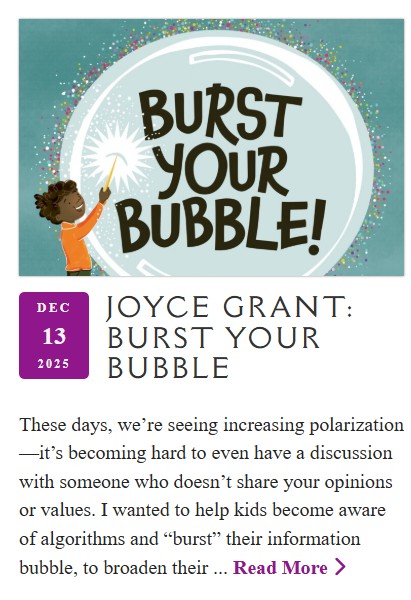
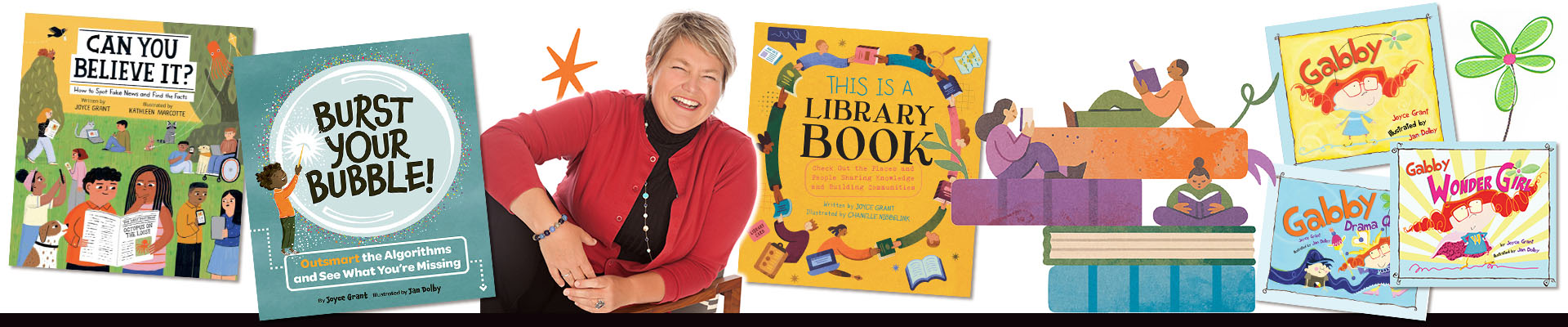
This month, she let me explore the many challenges that were overcome (by myself, Jan Dolby and the Owlkids team) to produce and fast-track Burst Your Bubble!
There’s an excerpt from the article below the image. Enjoy the entire article on Carmichael’s blog here: https://www.lecarmichael.ca/2025/12/joyce-grant-burst-your-bubble/
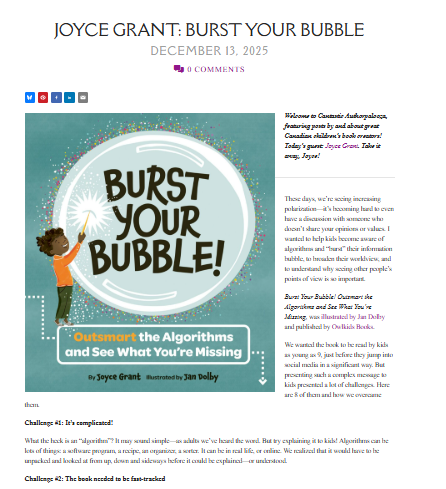
Excerpt from the article “Joyce Grant: Burst Your Bubble” on L. E. Carmichael’s blog:
Challenge #1: It’s complicated!
What the heck is an “algorithm”? It may sound simple—as adults we’ve heard the word. But try explaining it to kids! Algorithms can be lots of things: a software program, a recipe, an organizer, a sorter. It can be in real life, or online. We realized that it would have to be unpacked and looked at from up, down and sideways before it could be explained—or understood.
Challenge #2: The book needed to be fast-tracked
Tech moves quickly. This book needed to be on shelves much faster than the standard three to four years that illustrated non-fiction often takes. Owlkids’ Jennifer Stokes signed me on the condition that I would be able to work quickly—and the same with the illustrator. As a veteran editor, Stokes was able to rejig the way her team worked, to cut the timeline down as much as possible. She shaved more than a year off the process, which was hugely important.
Challenge #3: It had to be scrupulously accurate
Even after years of research and with a supportive team of fact-checkers and editors, I stayed up nights worrying that I might misinterpret a technological term or leave something out. We needed a tech expert who could help me understand some of the more complicated concepts, and the ones coming up in the future, which I would then break down to make them accessible to kids. Morten Rand-Hendrickson was a tech hero of mine for many years. He studies and teaches about algorithms, software and AI and the effects it has on us, looking at tech in human and ethical terms. The minute we reached out, he was all-in. He understood what we were trying to do and not only generously gave us his time and expertise, but he also wanted to help spread the word about our book. He wrote a blurb for the back cover and he has recently purchased a large quantity of books which he is donating to the public school libraries in his province. We relied on other experts as well, who gave their time and knowledge, and to all of them I am very grateful.
Challenge #4: It couldn’t be boring!
This isn’t a textbook. It needed to be engaging and funny. I injected as much humour as possible into every sentence. We then needed to find a great illustrator who could come at these complicated subjects from a humorous angle. And we did: Jan Dolby, whose illustrations are quirky and often hilarious, also had tremendous digital experience so she could work at the speed necessary to fast-track the book.
Continue reading this article: https://www.lecarmichael.ca/2025/12/joyce-grant-burst-your-bubble/